Geometry as Dialogue: Mathematical Patterns in Architecture
Long before architects could compute them, they were drawing patterns that mathematics would only later name. A reflection on why geometry still matters, and why it never decides alone.
By Carmelo Zappulla, PhD Architect, CEO & Head of Design of External Reference
Nature does not copy geometry. It interprets it. A shell, a leaf, a branching tree all follow abstract mathematical rules, yet each bends them to the conditions it meets: the quality of the soil, the sunlight available, the presence of other plants. Mathematics offers general models; nature uses them with a certain degree of freedom.
The history of architecture tells a similar story. Again and again, architects have discovered and used mathematical structures on their own, guided by intuition rather than proof. Some of these geometries were probably not yet known to mathematicians when the buildings were conceived, but they could already be read in the natural world. The application was deliberate even when the theory was missing.
Patterns as an exchange, not a formula
This metaphor of nature interpreting geometry clears away a common misunderstanding: that working with patterns means applying them uncritically, as a ready-made formula. In architecture, the use of patterns is an intellectual exchange between the ideal elements of geometry and the pragmatism of building. The pattern proposes; architecture decides.
Seen this way, mathematical patterns are well suited to the demands of contemporary work. Not because they are new, but because architects have always used the opportunities mathematics offers, and in some cases contributed to the advancement of mathematics itself. Three ideas follow from that history:
Patterns are a visual language. Mathematics can be reduced to patterns that open a wide range of formal and diagrammatic readings within a project.
Patterns free invention and hold it together. Their abstraction does not restrain creativity; it produces novelty. At the same time, whether used consciously or not, they give a project coherence and help it develop as a system.
Geometry gives control, not success. A pattern can discipline form, but it cannot guarantee that a project works. That judgement remains the architect’s.
From intuition to computation
What was once intuition is now computation. Parametric and computational design let us test a pattern against real conditions before anything is built, much as nature tests geometry against its environment. The principle has not changed; the precision has.
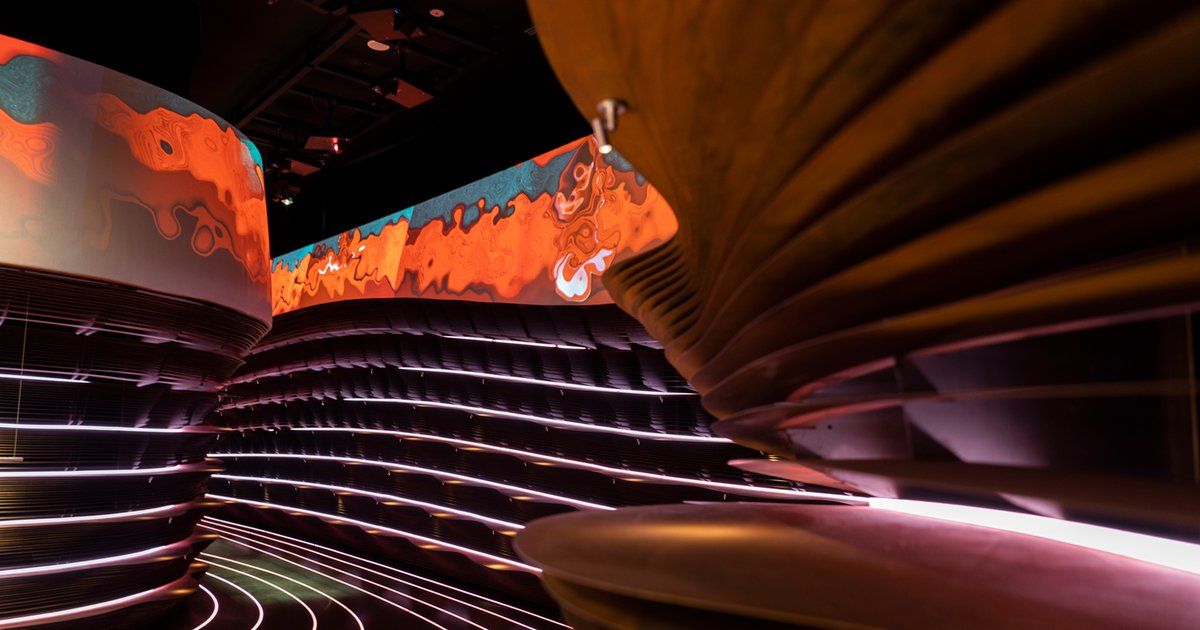
At External Reference, this shows up in very different scales and programmes. At Presentedby in Doha, a sneaker flagship inspired by Qatar’s dunes, algorithmically cut metal blades turn a landscape into a rhythm. At Plaza Mahou, beside the Bernabéu, 3D-printed ceiling panels translate a pattern directly into fabrication. In the Garagum Hotel concept near Ashgabat, the form is shaped with computational wind analysis to ventilate naturally. In each case, geometry is the starting point of a conversation with climate, material, brand and the people who will use the space.
The architect’s part
Mathematical patterns will keep offering architecture order, invention and coherence. But the interesting work happens in the gap between the ideal pattern and the real place, in the same freedom with which nature interprets its rules. That gap is where architecture begins.
Explore how we research geometry, fabrication and data-driven design at the External Research Lab